From Binface memes to small nuclear reactors, an online argument about AI is becoming a rather larger debate about electricity, infrastructure and who pays for the future.
Reading time: approximately 7 minutes
An Emerging Debate from the Binface Discursive Circus
The UK has spent the past week watching one of the more surreal episodes in modern politics: a social media contest between the leader of a right-wing political party and Count Binface. Predictably, the internet has responded in the only way it knows how—with an avalanche of memes, many of them clearly the work of artificial intelligence. Beneath the jokes, however, something more interesting has begun to emerge. Emerging from the Binface discursive circus is an argument that, sooner or later, was always going to arrive. For months, artificial intelligence has largely been discussed in terms of plagiarism, jobs, hallucinations, education, copyright, existential risk, or whether it can finally explain your broadband bill better than your provider can. Increasingly, however, another question is bubbling to the surface: where does all the electricity come from?
The Question Nobody Was Asking
It is the sort of question that begins innocently enough and, within half a dozen replies on social media, has somehow become an argument about capitalism, climate change, China, billionaires, nuclear physics, and the future of civilisation. Like all the best internet debates, it starts with a kilowatt-hour and ends with somebody accusing somebody else of destroying humanity.
The discussion is understandable. Modern AI systems require enormous computing infrastructure (Royal Society, AI and the Future of Work; International Energy Agency, Energy and AI). Training the largest models involves thousands of specialist processors operating continuously for weeks or months. Once those systems are built, they must also answer millions—sometimes billions—of requests. Every prompt, image generation or voice conversation consumes processing power, which ultimately means electricity and cooling. Individually these interactions may be modest; collectively they are contributing to one of the fastest-growing new sources of demand on electrical infrastructure (International Energy Agency, Energy and AI; National Energy System Operator).
The International Energy Agency estimates that global electricity consumption by data centres could more than double by 2030, reaching around 945 terawatt-hours by 2030—slightly more than Japan consumes today. AI is expected to be the largest driver of that increase (International Energy Agency, Energy and AI, 2025). This is no longer a matter of somebody leaving a laptop charger plugged in overnight. It is an industrial demand arriving at national scale.
That rapid growth has collided with an already strained energy system. Data centres were once the invisible plumbing of the internet. Today they are becoming strategic national infrastructure (National Energy System Operator; Department for Energy Security and Net Zero). Utility companies are revising forecasts. Governments are reassessing electricity demand that, only a few years ago, nobody predicted would rise quite so quickly. Suddenly, discussions that once belonged to electrical engineers have escaped into mainstream politics.
More Heat Than Light
As ever, public debate has raced ahead of nuance. One side presents AI as an environmental catastrophe in waiting, suggesting that every chatbot conversation accelerates climate collapse. The other dismisses such concerns as little more than digital Luddism, arguing that technological progress has always consumed resources before becoming more efficient. Between those poles lies a rather more interesting reality, although it receives considerably fewer retweets.
Part of the confusion stems from the fact that the technology itself is evolving at remarkable speed. New generations of processors perform more calculations for the same amount of electricity. Software engineers are discovering increasingly clever ways to reduce computational waste. Researchers are designing smaller systems capable of results that recently required much larger ones (Stanford AI Index 2025; Royal Society, Machine Learning: The Power and Promise of Computers that Learn by Example).
The Stanford AI Index, for example, found that the cost of using a model performing at roughly the level of GPT-3.5 fell by more than 280-fold between November 2022 and October 2024 (Stanford AI Index, 2025). Financial cost is not identical to energy consumption, of course, but it is evidence of an industry becoming dramatically more efficient. In computing, improvements are rarely incremental; occasionally they are breathtaking. The question is no longer whether AI will need vast amounts of electricity. The question is how we choose to generate it. Industry, meanwhile, is behaving as though demand will continue climbing regardless.
“The debate about whether AI requires vast quantities of power has already been answered by policymakers: they are planning for it.”
Governments, too, have begun to treat the issue as one of strategic infrastructure rather than simply another commercial opportunity. In the United States, the Department of Energy has identified federal sites capable of hosting AI data centres alongside new electricity generation, later selecting several locations to move forward with development proposals (US Department of Energy, Powering America's AI Future; Reuters).
The significance is not merely that America wants more server sheds. These locations were chosen because they already possess land, grid connections and the potential to accelerate new electricity generation. In other words, Washington has started planning data centres and power stations as parts of the same system. AI is no longer simply a software industry; it is becoming an infrastructure industry (US Department of Energy; International Energy Agency).
The US government has also committed substantial funding towards the next generation of nuclear technology. Through its Advanced Reactor Demonstration Programme, the Department of Energy has committed hundreds of millions of dollars to accelerate the commercial deployment of Small Modular Reactors (SMRs), reflecting renewed political interest in nuclear energy as electricity demand begins to rise once more (US Department of Energy; International Atomic Energy Agency).
Powering the Machines
In effect, the debate about whether AI requires vast quantities of power has already been answered by policymakers: they are planning for it. The argument is moving on to where that power will be generated, how quickly new infrastructure can be built, and who will pay for it.
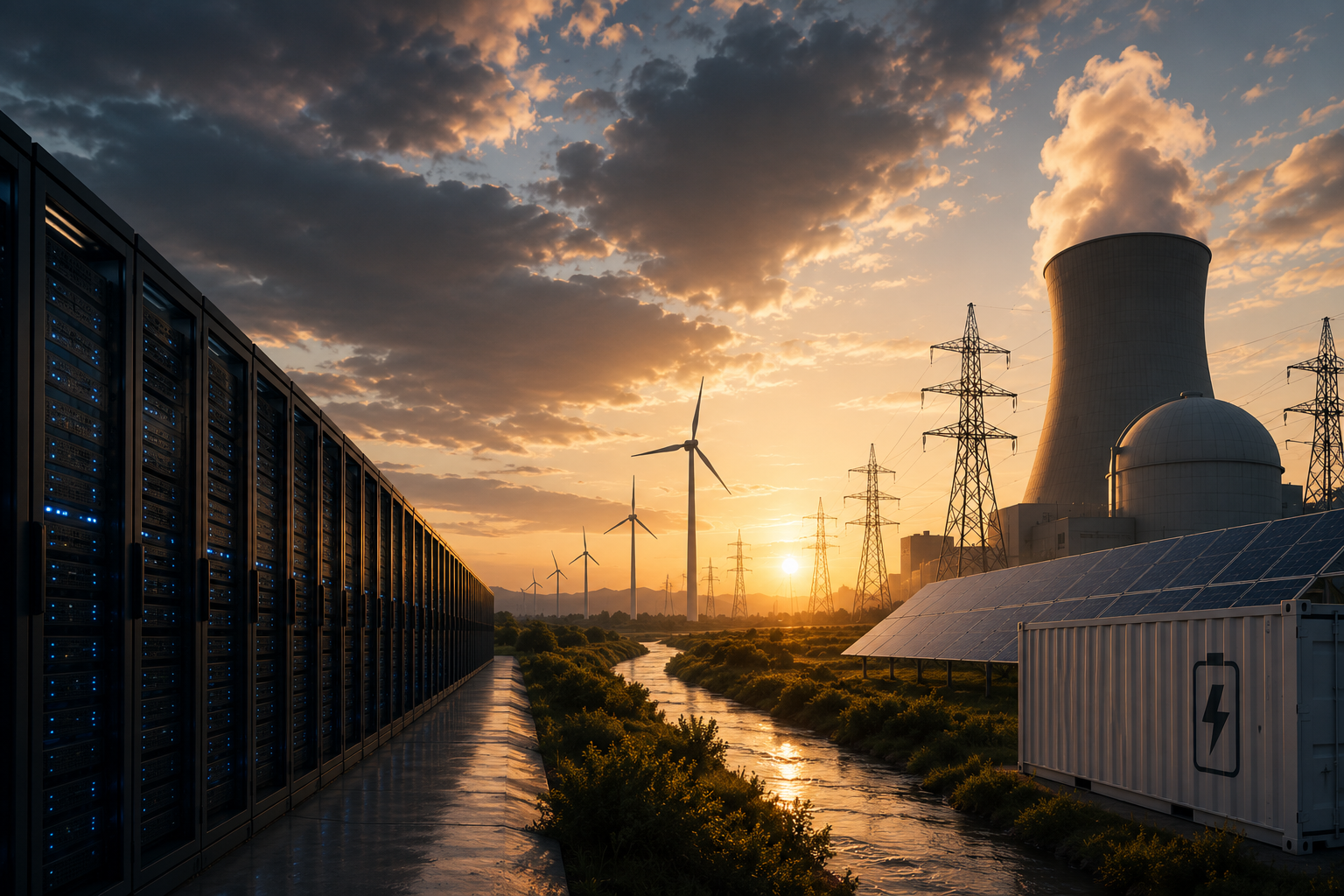
Technology companies are investing not merely in servers but in power generation itself. Small Modular Reactors (SMRs)—advanced nuclear reactors capable of producing up to around 300 megawatts of electricity per unit—have shifted from technical papers to boardroom strategy (International Atomic Energy Agency; Royal Society).
Their attraction is obvious: they promise reliable, low-carbon electricity in smaller, potentially repeatable units that could eventually be located close to major industrial demand. Their advocates hope factory manufacture and standardised designs will make them quicker and less expensive to deploy than conventional nuclear power stations. Whether they ultimately achieve those ambitions remains uncertain, but the fact they are now being discussed seriously tells its own story (International Atomic Energy Agency; House of Commons Library).
The technology sector is not merely waiting for governments. Google has signed agreements with Kairos Power to purchase electricity from a fleet of planned Small Modular Reactors, while working with the Tennessee Valley Authority on the infrastructure needed to support future AI data centres (Google; Kairos Power; Tennessee Valley Authority). Whether those projects ultimately prove commercially successful remains to be seen, but they illustrate just how seriously the industry's largest companies are taking the question of future electricity supply.
Nor is nuclear the only idea under consideration. Companies are exploring geothermal energy, advanced battery storage, dedicated renewable installations and entirely new approaches to cooling data centres. The International Energy Agency expects renewable energy to provide almost half of the additional global electricity required by data centres over the coming years, although natural gas, existing coal generation and, increasingly, nuclear power are also expected to play important roles (International Energy Agency, Energy and AI).
Some proposals sound almost like science fiction because, at present, they largely are. Elon Musk has just been given funds through his Space X Programme, to develop and place AI computing infrastructure in orbit, using satellites powered by continuous solar energy. It is an arresting idea, but the engineering challenges are formidable. Space offers abundant sunlight, yet it also makes cooling extremely difficult. Heat cannot simply be blown away in a vacuum, while radiation, maintenance, launch costs and orbital debris present further obstacles (Royal Academy of Engineering; Reuters). The serious point is not that terrestrial data centres will be packed into rockets next Tuesday. It is that the industry's appetite for electricity has become large enough to make orbital computing sound less like science fiction and more like a serious engineering discussion.
China offers another interesting perspective. Rather than relying solely on ever larger data centres, Chinese developers have invested heavily in techniques that reduce the amount of computing required to achieve comparable results. DeepSeek's work on model efficiency is one example of a broader movement towards doing more with less (DeepSeek Technical Report; Nature; Stanford AI Index). Whether this reflects necessity, commercial strategy or technical philosophy remains open to debate, but it demonstrates that increasing supply is only one half of the equation.
Either way, it illustrates that there is more than one route through the problem: produce more electricity, use less electricity, or—most likely—both. Efficiency matters enormously. Yet history offers a note of caution. Cheaper and more efficient technology does not necessarily reduce overall consumption. Quite often, it encourages people to use much more of it—a phenomenon economists have recognised for well over a century as the Jevons Paradox (UK Energy Research Centre; House of Commons POST; Jevons, 1865). The more efficient motorcar did not empty the roads.
Catching Up with the Future
This leaves the wider public in an awkward position. It is tempting to frame the discussion as a simple moral choice: either halt AI until its environmental footprint shrinks, or embrace it regardless because better technology is surely around the corner. Reality is rarely so accommodating.
History suggests innovation often solves yesterday's constraints while simultaneously creating tomorrow's opportunities. Equally, history reminds us that assuming future technology will rescue today's policy mistakes is not a strategy. It is a gamble wearing a laboratory coat.
Perhaps, then, the debate itself needs to mature. Instead of endlessly rehearsing whether AI is good or bad, or treating every new energy estimate as either proof of apocalypse or evidence of irrational panic, we might ask more useful questions. Which applications genuinely justify the energy they consume? Which efficiencies deserve investment? Which forms of electricity generation should governments accelerate? How quickly can electricity grids be expanded? Who pays for the new substations, transmission lines and power stations? Where should public policy intervene, and where should markets be allowed to experiment?
The argument has escaped the Binface phase. That, in itself, is progress. AI's energy consumption is no longer an obscure technical footnote but a legitimate public-policy question. More than that, it is beginning to reshape national energy policy: influencing which power stations are financed, where generating capacity is built, how electricity grids are regulated and which technologies governments are prepared to subsidise (Department for Energy Security and Net Zero; National Energy System Operator; International Energy Agency).
Yet it is also an issue moving at extraordinary speed. By the time social media has finished arguing about today's numbers, engineers may already have built hardware that changes the calculation again. That does not mean the discussion should be postponed. It means the discussion must remain capable of changing as the evidence changes.
“The real choice is not whether to stop AI. It is whether public debate can keep pace with technological change.”
So perhaps the choice is not between stopping AI or letting it ride. The real choice is whether public debate can keep pace with technological change. We should absolutely question AI's appetite for energy. We should also recognise that the technologies intended to feed—and tame—that appetite are evolving just as quickly. Standing still while waiting for perfect certainty is every bit as much a decision as racing ahead regardless.
The sensible course is neither panic nor complacency. It is to have the argument now, before the infrastructure becomes fixed, while accepting that the answer may look rather different in five years' time than it does today. If the debate can move beyond slogans and into evidence, everyone—including the machines—stands to gain.
Further Reading
If this article has piqued your curiosity, these are excellent places to continue the conversation.
- Royal Society – Machine Learning: The Power and Promise of Computers that Learn by Example
https://royalsociety.org/ - Parliamentary Office of Science and Technology (POST) – AI, Energy and Emerging Technologies Briefings
https://post.parliament.uk/ - House of Commons Library – Energy policy and artificial intelligence research briefings
https://commonslibrary.parliament.uk/ - Department for Energy Security and Net Zero (DESNZ)
https://www.gov.uk/government/organisations/department-for-energy-security-and-net-zero - National Energy System Operator (NESO)
https://www.neso.energy/ - International Energy Agency – Energy and AI
https://www.iea.org/reports/energy-and-ai - International Atomic Energy Agency – Small Modular Reactors
https://www.iaea.org/topics/small-modular-reactors - Stanford University – AI Index Report 2025
https://hai.stanford.edu/ai-index - Google & Kairos Power – Advanced Nuclear Energy Agreement
https://blog.google/outreach-initiatives/sustainability/google-kairos-power-nuclear-energy-agreement/ - DeepSeek – Technical Report
https://github.com/deepseek-ai